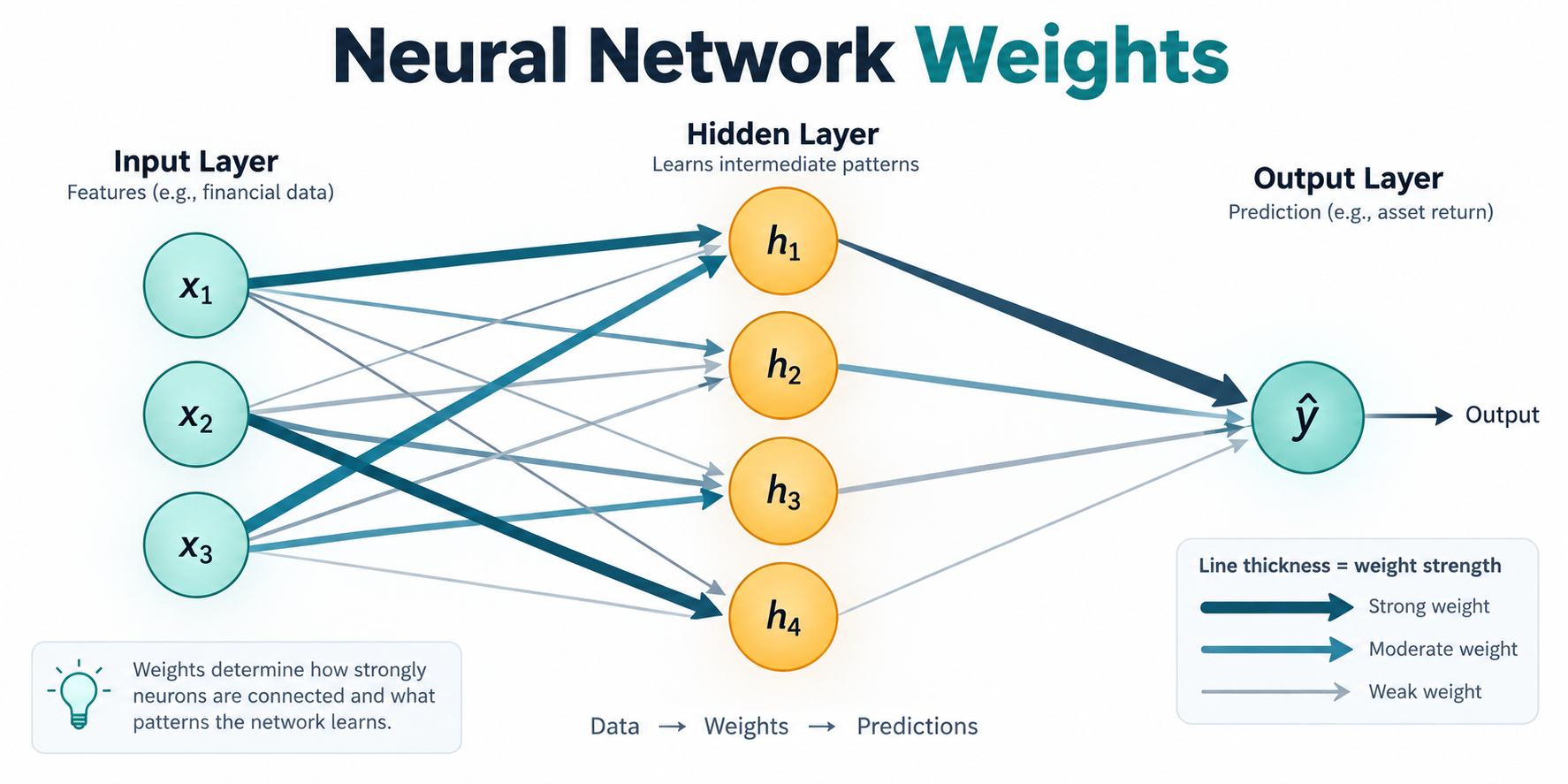
Weights are one of the most important ideas in a neural network. They decide how strongly one neuron influences another. When people say a neural network “learns,” much of that learning happens through the adjustment of weights.
What Is a Weight in a Neural Network?
A neural network receives inputs, passes information through layers, and produces an output. Each connection between neurons has a number attached to it. That number is called a weight.
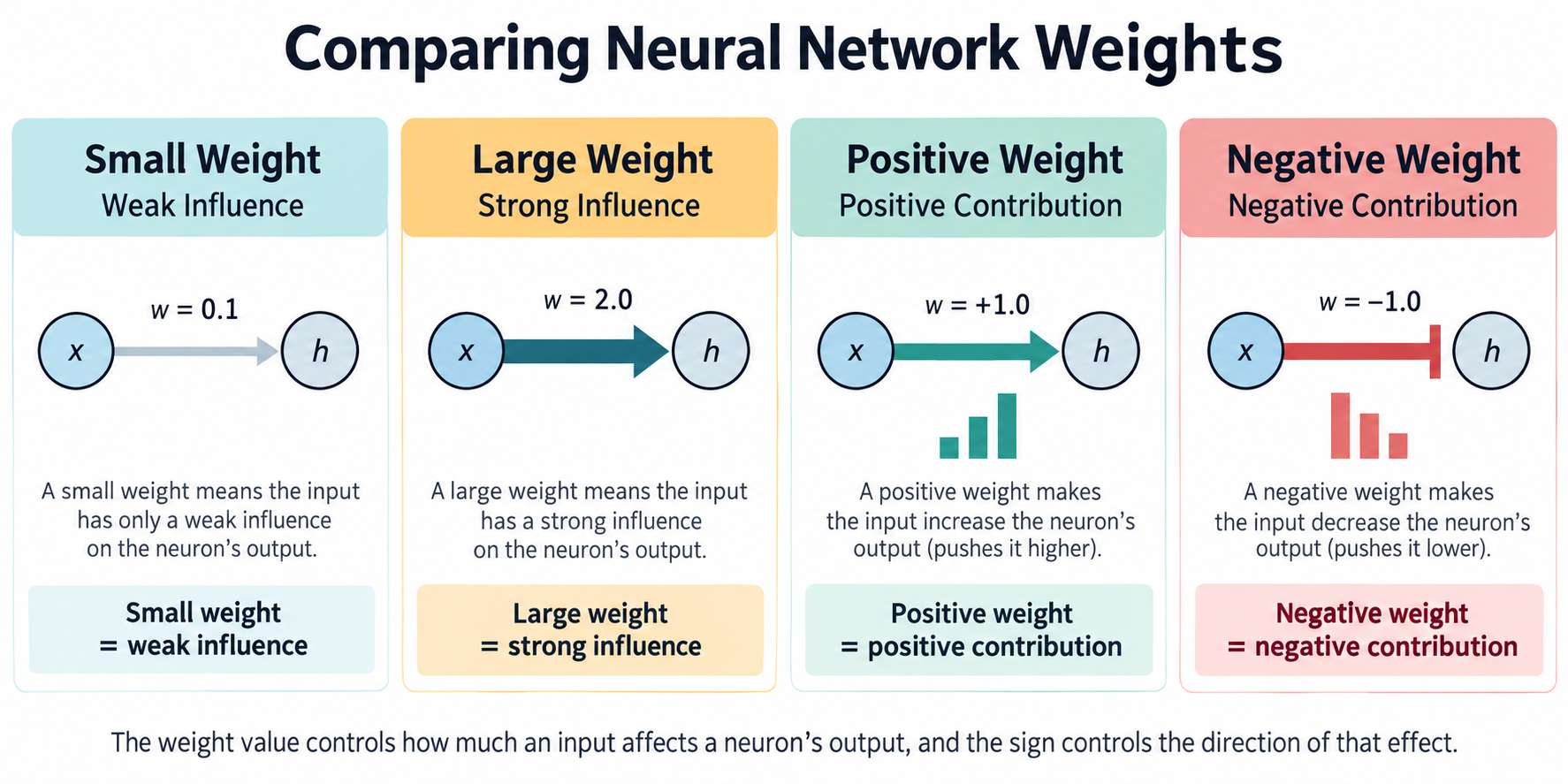
If a weight is large, the input has a strong effect on the next neuron. If a weight is small, the input has a weaker effect. If the weight is negative, it can reduce or suppress the neuron’s output instead of increasing it.
Why Weights Matter
Weights matter because they determine what patterns the model pays attention to. In a simple image model, some weights may become sensitive to edges, curves, colors, or shapes. In a financial model, weights may become sensitive to volatility, trend strength, liquidity, macro signals, or recent returns.
The network does not begin with perfect weights. It starts with rough initial values, makes predictions, measures its error, and then adjusts the weights to reduce that error. This repeated adjustment is the core of training.
Weights vs. Biases
Weights and biases are related, but they are not the same thing. A weight controls the strength of an input. A bias shifts the neuron’s baseline output.
Think of a weight as deciding how much a signal matters, while a bias decides how easy it is for the neuron to activate in the first place. Both are learned during training, and both affect the final prediction.
Small Weights vs. Large Weights
A small weight means the model is giving an input only a small amount of influence. A large weight means the input has a stronger influence on the next layer. This does not automatically mean large weights are better. If weights become too large, the model can become unstable or overfit the training data.
Good training is not about making every weight large. It is about finding the right balance of influence across many features.
Positive Weights vs. Negative Weights
A positive weight pushes a neuron’s output higher when the input increases. A negative weight pushes the output lower when the input increases.
This distinction is important because neural networks do not only learn what supports a prediction. They also learn what works against it. For example, in a credit risk model, one feature might increase estimated risk while another feature reduces it. The signs and sizes of weights help the network represent those relationships.
Weights During Training
Training usually follows a loop:
- The model receives input data.
- It makes a prediction using its current weights.
- The prediction is compared with the correct answer or target.
- The error is calculated through a loss function.
- Backpropagation estimates how each weight contributed to the error.
- An optimizer updates the weights to improve future predictions.
This process happens many times. Each pass through the data slightly changes the weights. Over time, the network becomes better at mapping inputs to useful outputs.
Comparison: Neural Network Weights vs. Human Rules
A traditional rule-based system depends on rules written by humans. For example: if volatility is high and trend is negative, reduce risk. A neural network can learn softer relationships by adjusting weights across many variables at once.
The advantage is flexibility. Neural networks can discover patterns that are difficult to write as simple rules. The tradeoff is interpretability. A rule is easy to read. A large set of learned weights can be harder to explain.
Comparison: Important Weights vs. Important Features
A feature is an input, such as price momentum, volume, or interest rates. A weight is the learned strength attached to that input or to an internal signal derived from it.
Important features often influence important weights, but the relationship is not always simple. In deep networks, information is transformed across many layers. A feature may matter because of how it interacts with other features, not because of one obvious weight.
Overfitting and Weight Regularization
If a model learns weights that are too tuned to the training data, it may perform poorly on new data. This is called overfitting.
Regularization methods help control this. L1 and L2 regularization discourage unnecessary or excessively large weights. Dropout can also reduce dependence on specific pathways in the network. These methods encourage the model to learn patterns that generalize better.
Why This Matters for AI and Finance
In finance, weights can determine how much a model responds to market signals. A trading model might learn that volatility matters more in one regime, while trend matters more in another. A credit model might learn that debt ratio, income stability, and payment history all influence risk differently.
This is why weights are not just technical details. They are the internal structure of the model’s decision-making. Understanding them helps explain how neural networks learn, why they sometimes fail, and how they can be improved.
Final Thoughts
Weights are the adjustable memory of a neural network. They store what the model has learned from data by controlling the strength and direction of signals between neurons.
Small weights create weak influence. Large weights create strong influence. Positive weights increase activation, while negative weights reduce it. During training, the network constantly adjusts these values until it finds a pattern that produces better predictions.
For anyone studying AI, machine learning, or financial modeling, weights are a foundation. They explain how a model turns raw data into learned behavior.